
Future of Hospitality
AI in Hotels: What to Automate and Where People Still Matter
Conversations about AI in hotels often swing between two extremes: it will change everything, or it is just hype. For a hotelier, a more useful question is practical: which specific tasks can be done better with its help, and where should a person stay in charge?
By RoomRack Editorial Team ·
What is true today, and what is a forecast
It helps to separate three things. There are applications already in use, such as answering frequent questions. There are industry trends, such as the growing use of assistants in guest communication. And there are forecasts about the future — which are exactly that. This article tries to keep the distinction clear.
Where it can help
- Repetitive guest questions: hours, services and directions, answered from knowledge the hotel itself has defined.
- Information retrieval: helping the team find policies, procedures or details quickly.
- Communication triage: recognising what a message is about and routing it to the right department.
- Operational alerts: flagging unusual changes, for example in bookings or cancellations.
- Data summarisation: short summaries of reports or reviews.
- Decision support: suggesting options, with the final decision left to the team.
- Personalisation, where appropriate: more relevant information, with respect for personal data.
Why these tasks
What they share is a clear context, low cost when an answer needs correcting, and real value in speed. If a guest can find breakfast hours at 2 a.m. without calling the desk, both sides benefit.
Quality, however, depends on the knowledge behind the system. If the hotel's information is incomplete or out of date, so are the answers. Maintaining that knowledge is human work.
Where people remain essential
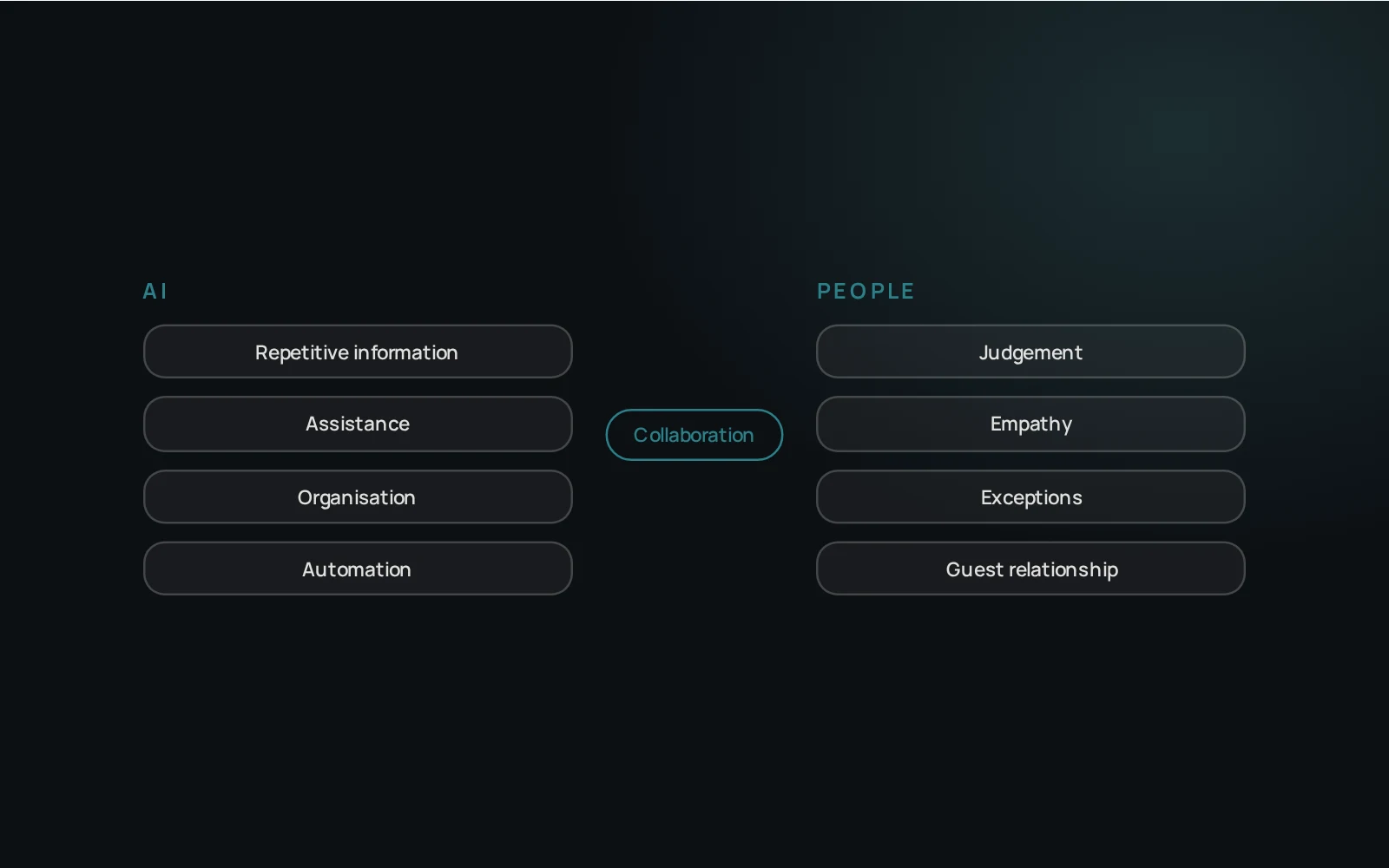
- Empathy: a tired or anxious guest needs understanding, not just an answer.
- Exceptions: anything outside the rules requires judgement.
- Complaints: handling a complaint well is a chance to rebuild trust.
- Judgement: decisions with financial or operational consequences.
- Sensitive situations: health, safety and personal matters.
- Hospitality: the warmth and attention that make a stay memorable.
- Relationships: with returning guests, partners and the local community.
The hand-over point
The most important quality of an AI assistant in a hotel is not how much it knows, but whether it recognises when to hand the conversation to a person. A system that keeps answering what it does not understand can do more harm than having no system at all.
AI does not understand every guest. It can misread tone, intent or cultural nuance. Design should therefore include easy access to a person and clear limits on what the system handles.
A practical matrix: automate, assist, escalate
One useful way to decide where AI belongs is to sort tasks into three groups. The examples below are indicative, not exhaustive; each property will draw the lines according to its guests, team and tools.
Automate
Tasks with a clear answer, low risk if corrected, and a high volume of repetition.
- Repetitive information requests, such as hours, directions or facilities.
- Basic routing of messages to the right department.
- Routine summaries, for example of the day's messages or a weekly report.
Assist
Tasks where AI prepares the ground and a person makes the final call.
- Drafting replies that a team member reviews before sending.
- Analysing patterns in reviews, bookings or requests.
- Surfacing relevant information during a conversation with a guest.
- Decision support, for example suggesting options for a pricing or staffing question.
Escalate to a person
Situations where judgement, responsibility or empathy matter more than speed.
- Complaints, including ones that seem minor.
- Sensitive situations involving health, safety or personal matters.
- Exceptions that fall outside the property's policies.
- Financial disputes, such as a contested charge or refund.
- Judgement-heavy cases with operational or legal consequences.
- Hospitality moments that call for empathy: an anniversary, a disappointment, a guest who simply needs to be heard.
Practical guide
Where AI is useful — and where escalation to a person matters
- Start with one repetitive task that has a clear context.
- Make sure the knowledge behind the system is accurate and current.
- Define which topics always go to a person: complaints, payments, health, safety.
- Make it easy for guests to ask for a person at any point.
- Review samples of conversations regularly for errors or gaps.
- Brief the team on the tool's role and how it supports them.
The RoomRack perspective
AI Concierge by AboutHotelier answers guest questions from knowledge the hotel defines and hands the conversation to the team when a person is needed. Unified Inbox and Intelligence support communication and a clearer view of data. None of them replaces the team.
Frequently asked questions
Will AI replace hotel staff?
That is not its purpose. In the most useful applications it takes on repetitive tasks so the team has more time for work that needs human judgement and hospitality.
Where do an AI assistant's answers come from?
In good implementations, from knowledge the hotel itself defines and checks: information, services and policies.
What happens when the assistant does not know the answer?
It should recognise this and hand the conversation to a person rather than guess.